Loading…
Ortahisar Castle
CastlesLocal favorite
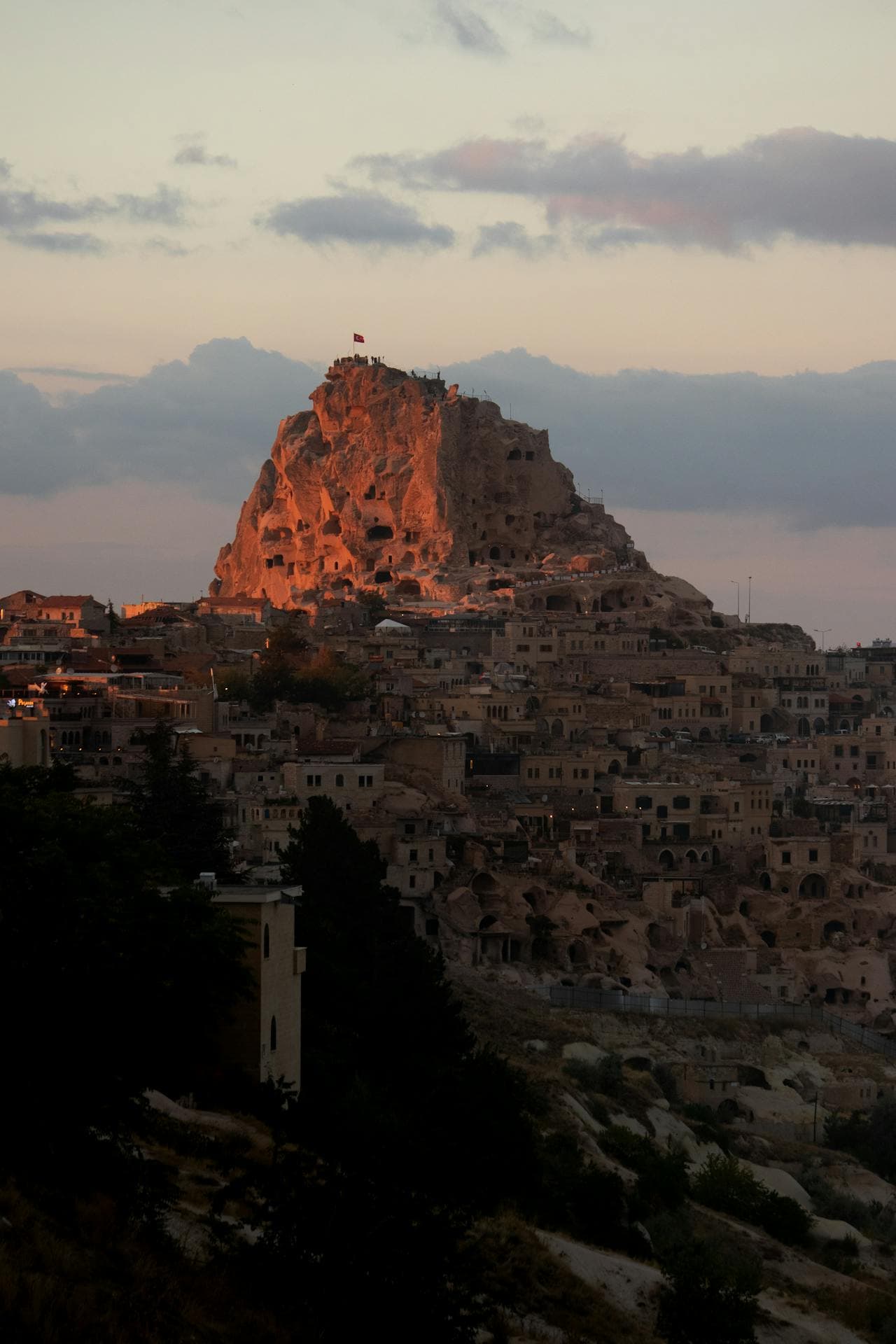
Ortahisar Castle is a roughly 86-metre rock-cut citadel rising from the middle of an authentic Cappadocian town, a quieter and more local alternative to Uçhisar. Honeycombed with old tunnels and chambers, it can be climbed for sweeping views over the valleys, Ürgüp and Mount Erciyes, above streets still famous for cave cold-storage.
Frequently asked questions
How tall is Ortahisar Castle and can you climb it?
The rock-cut citadel stands roughly 86 metres high. When it is open, steps and railings lead up through the hollowed interior to a viewing platform. It has closed at times for restoration and safety work, so check locally that the climb is open before you go.
How is Ortahisar Castle different from Uçhisar Castle?
Both are honeycombed rock citadels, but Ortahisar is shorter, far less crowded and sits in a genuine working town rather than a tourist hub. It is the place to combine a castle climb with authentic village streets, old Greek stone houses and the famous cave cold-storage cellars.
How do I get to Ortahisar from Göreme or Ürgüp?
Ortahisar lies between the two, about 6 kilometres from Ürgüp and a short hop from Göreme. A taxi or rental car is easiest, but frequent minibuses (dolmuş) run the Nevşehir–Ürgüp route and some stop near the Ortahisar turn-off, a short walk from the centre. Several valley trails also link it to Göreme on foot.
What is the best time to visit and how long do I need?
Late afternoon into sunset is best, when the low sun turns the tuff golden and the view from the top is at its finest; mornings are quieter and cooler. Allow about one to one and a half hours to combine the castle with a wander through town, or longer if you stop for tea and lunch on the square.
Is Ortahisar Castle suitable for children or people afraid of heights?
The climb has steep steps and real drops, so it is not ideal for very young children or anyone with vertigo. Sensible shoes help on the worn stone, and there is little shade at the top, so bring a hat and water in summer. If the summit is closed, the town below is still well worth the visit.
More Castles
Castles
Uçhisar Castle
Uçhisar Castle is the highest point in Cappadocia — a giant rock fortress you climb for a 360-degree view over Göreme, Pigeon Valley and Mount Erciyes. It isn't a built castle of walls and towers but a single massive outcrop of soft volcanic tuff that generations hollowed into a honeycomb of rooms, tunnels, storage pits and lookout points. At roughly 1,360 metres it towers over the village of Uçhisar, and the short climb to the summit platform is the best way to understand Cappadocia's landscape at a glance. Most visitors photograph the castle from a distance without realising you can go inside and up. Climbing it rewards you three ways: the view, the history you can touch in its carved chambers, and the timing — because it is the tallest point around, it is a front-row seat for both sunrise balloon launches and the golden light of sunset. From the summit you look straight down Pigeon Valley toward Göreme, across a sea of fairy chimneys, with the snow-capped cone of Mount Erciyes on the horizon on clear days. At sunrise, dozens of hot-air balloons rise from the Göreme basin directly in your line of sight. Getting there is easy. From Göreme, about 7 km away, the Göreme–Nevşehir dolmuş minibus stops in Uçhisar, and a taxi takes about 10 minutes. For something more scenic, walk the roughly 4 km Pigeon Valley trail from Göreme — one of the region's best easy hikes — and finish with the castle climb. Go for sunset if you want the best light and the classic golden-hour panorama, or arrive before sunrise to watch the balloons from above. Budget 45 to 60 minutes: about 10 minutes up the carved, railed steps, time at the top, and a wander around the base and the village lanes. It gets genuinely windy and exposed at the summit, so bring a layer even in summer and wear grippy shoes, as the tuff steps can be slick. There is a small entrance fee, so bring cash. Uçhisar itself is worth lingering in, with its cave hotels, viewpoint cafés and craft shops making an easy half-day. The castle is steep in places with real drops, so it is less suitable for anyone with serious mobility limits or a strong fear of heights.
Castles
Nevşehir Castle
Nevşehir Castle is a Seljuk-era hilltop fortress rising over the centre of Nevşehir, the provincial capital of Cappadocia, dating back to the 11th century. Most travellers rush through Nevşehir on their way to Göreme or Ürgüp without realising that the city has its own crown. Perched on a rocky hill right in the middle of town, the castle has watched over this crossroads of Anatolia for nearly a thousand years. It was raised during the Seljuk period, when this region sat on busy trade and pilgrimage routes, and although time and earthquakes have worn down much of the structure, the surviving walls and the stout tower still command the skyline. What makes it special is not the size of the ruins but the sense of standing at the very heart of Cappadocia, with the whole province spreading out below you. The story of the castle is tied to the story of the city itself. For centuries the settlement here was a modest village called Muşkara. Everything changed in the early 18th century, when Damat İbrahim Paşa, the powerful grand vizier of Sultan Ahmed III during the Tulip Era, was born in this village. He lavished attention on his hometown, renaming it Nevşehir, meaning New City, and funding a grand mosque and social complex. That elegant Ottoman külliye, the Damat İbrahim Paşa Mosque with its medrese, fountain and hamam, still sits at the foot of the castle hill and is well worth pairing with your climb. At the top you will find weathered stone walls, the remains of the tower, and above all the view. On a clear day you can trace the layout of the modern city, pick out minarets and rooftops, and look out over the plains and distant volcanic hills that shaped Cappadocia's famous landscape. It is a quiet, uncommercial spot. There are no crowds, no long queues, just a handful of locals and the occasional curious traveller enjoying one of the best free-feeling panoramas in the region. Getting there is easy because the castle is right in the centre of Nevşehir. If you are staying in Nevşehir, it is a short uphill walk from the bazaar and the main mosque; simply aim for the hill you can see from almost anywhere in town. Coming from Göreme or Ürgüp, hop on one of the frequent dolmuş minibuses that connect the villages with Nevşehir's centre and otogar; the ride takes roughly half an hour, and from the drop-off it is a modest walk up to the castle and mosque complex. Many visitors combine the castle with a practical stop in Nevşehir, since this is the transport hub where regional bus connections meet. The best time to visit is late afternoon, when the light softens and the view stretches golden across the plains, or early morning if you want cool air and empty lanes. You do not need long here. Allow around thirty to forty-five minutes for the climb, the walls and the photos, or an hour or two if you also explore the mosque complex and the surrounding old streets. Access to the immediate viewpoint is generally straightforward, though sections of the castle may be fenced or under conservation, so read any signs and keep to safe paths. A few honest tips will make the trip smoother. Wear comfortable shoes, as the final approach is steep and the stones can be uneven. Bring water in summer, when Nevşehir gets hot and shade is limited on the hilltop. This is a local landmark rather than a polished tourist attraction, so set your expectations accordingly; the reward is atmosphere and views, not museum displays. Pair it with the Damat İbrahim Paşa complex, a wander through the traditional bazaar, and a tea in a local café to get a genuine feel for everyday Cappadocian city life that most fairy-chimney tourists never see. If you are short on time, even a brief detour up the hill gives you a memorable perspective on the region and a quiet moment away from the busier valleys.
Nearby places
Churches & Monasteries
Valleys
Open Air Museum
Valleys
Churches & Monasteries
Pro tip
The best time to visit is during the sunrise golden hour. Don't forget your camera!